
Beyond the AI Scribe: How Agentic AI Could Transform the Healthcare Workflow
From generating clinical notes to coordinating intelligent healthcare workflows
Artificial intelligence is rapidly becoming part of everyday healthcare. Large language models can summarize records, generate clinical documentation, extract information from medical charts, and assist clinicians with increasingly complex tasks.
But generating an answer—or generating a note—is only the beginning.
The next evolution may be Agentic AI: AI systems designed not simply to respond to a prompt, but to perceive information, reason about it, coordinate multiple specialized tasks, take actions, evaluate the results, and continuously adapt.
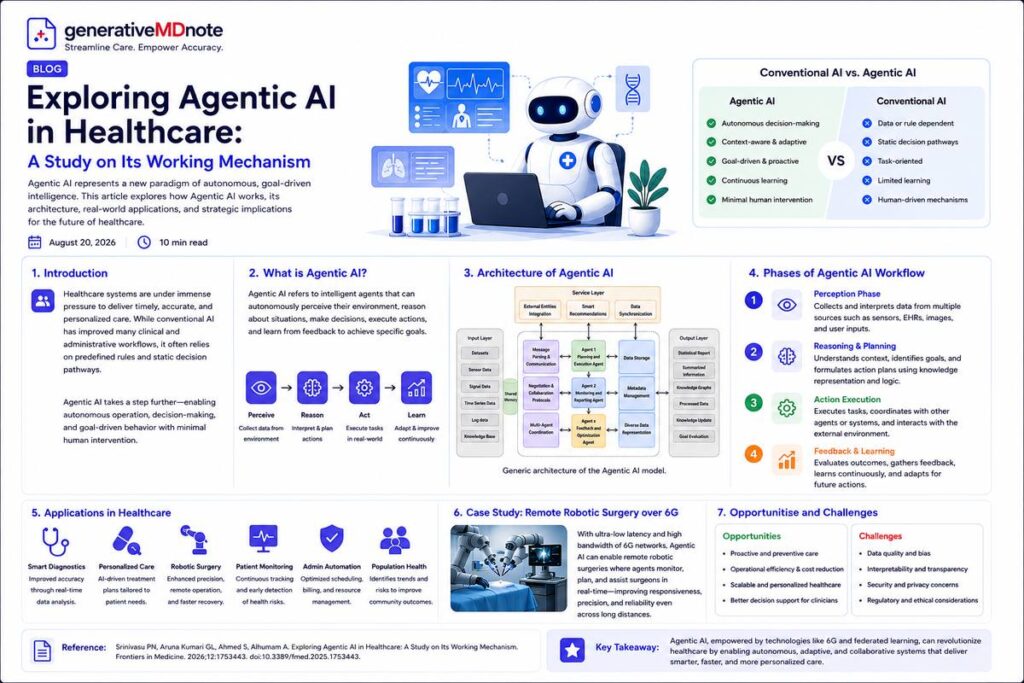
A recent article by Srinivasu and colleagues, Exploring Agentic AI in Healthcare: A Study on Its Working Mechanism, describes an architecture in which multiple specialized AI agents can work together across complex healthcare environments.
For healthcare, this distinction could be profound.
At GenerativeMDnote, we believe ambient documentation represents an important entry point for AI in medicine—but the larger opportunity is to rethink the clinical workflow itself.
From Generative AI to Agentic AI
Most of the AI tools clinicians use today operate within relatively defined boundaries.
A clinician provides information or a prompt. The AI processes the information. It produces an output.
For example:
Clinical conversation → transcription → AI model → clinical note
That workflow can save substantial documentation time, but the clinician still coordinates almost everything surrounding it.
Agentic AI introduces a different model.
Instead of asking one AI model to perform one task, an agentic architecture can divide a larger objective among specialized agents that communicate with one another.
The system may:
PERCEIVE → REASON → PLAN → ACT → EVALUATE → LEARN
The article describes four closely connected phases: perception, reasoning and planning, action, and learning/feedback.
1. Perception
The system gathers and interprets information from multiple sources.
In healthcare, these could eventually include:
- Physician-patient conversations
- Electronic health records
- Laboratory results
- Medical imaging
- Physiologic signals
- Wearables
- Remote monitoring devices
- Patient-generated information
- Other structured and unstructured clinical data
2. Reasoning and Planning
The system evaluates the available information, determines objectives, and develops a sequence of actions.
Importantly, this does not necessarily mean a single model makes every decision.
Different agents can perform different functions.
3. Action
The system executes the appropriate workflow or interacts with another digital system through tools such as APIs and workflow automation.
4. Learning and Feedback
The system evaluates what happened, incorporates feedback, and potentially improves subsequent performance.
This continuous loop is one of the important conceptual differences between a traditional AI application and an agentic system.
One AI Model Doesn’t Have to Do Everything
One of the most interesting concepts described in the paper is multi-agent orchestration.
Instead of creating one enormous AI system responsible for every healthcare task, multiple specialized agents can collaborate.
Imagine a future clinical encounter.
A documentation agent listens to the encounter and constructs the clinical note.
A medical-record agent retrieves relevant information from the longitudinal record.
A results agent identifies important laboratory, imaging, and diagnostic findings.
A quality agent evaluates whether relevant quality measures have been addressed.
A coding agent examines the documentation for coding completeness.
A follow-up agent identifies tasks requiring future action.
A patient-education agent prepares appropriate educational information.
An orchestration layer coordinates these agents and determines which task should occur next.
The physician would not need to independently activate every tool.
That is the potential transition from AI-assisted documentation to an AI-assisted clinical workflow.
The Healthcare AI Workflow Could Become Agentic
Consider a typical outpatient visit today.
The physician reviews the chart, interviews the patient, performs the examination, interprets diagnostic information, develops an assessment and plan, documents the encounter, enters orders, completes coding requirements, provides instructions, and coordinates follow-up.
Much of that workflow consists of moving information between systems.
Agentic architectures could eventually allow AI to coordinate many of these steps.
For example:
Patient encounter
↓
Ambient clinical capture
↓
Clinical information extraction
↓
Medical record retrieval
↓
Specialized AI agents
Documentation | Results | Quality | Coding | Patient Education | Follow-up
↓
Validation and orchestration
↓
Physician review
↓
Final documentation and appropriate downstream actions
The objective should not be to remove the physician from clinical decision-making.
The objective should be to remove unnecessary friction surrounding clinical decision-making.
Why Agent Orchestration Matters
A particularly important component described in the article is the orchestration layer.
If multiple AI agents operate simultaneously, something must determine:
- Which agent performs each task
- Which information each agent receives
- The order in which tasks occur
- Whether an output has sufficient confidence
- What happens when agents disagree
- When a task should be escalated
- What actions were performed
The framework discussed by the authors includes mechanisms for agent registration, task dependencies, ranking, escalation, and auditing.
This becomes especially important in healthcare.
A healthcare AI system should not simply produce an answer.
It should be possible to understand how the workflow reached that answer and what the system did with it.
The Importance of the Human in the Loop
Increasing autonomy does not mean eliminating human oversight.
In medicine, it should mean the opposite.
As AI systems become capable of performing more tasks, appropriate human-in-the-loop checkpoints become increasingly important.
An agentic clinical system could potentially escalate an output when:
- Confidence falls below an established threshold
- Important information is missing
- Different agents produce conflicting conclusions
- An action carries significant clinical consequences
- A recommendation requires physician judgment
The physician then becomes the supervisor of an increasingly intelligent digital workflow rather than the operator of dozens of disconnected administrative systems.
That distinction matters.
The goal should be:
Automate the workflow surrounding clinical judgment—not clinical responsibility itself.
Agentic AI Could Extend Far Beyond Documentation
The article describes applications extending across clinical and operational healthcare, including patient monitoring, diagnostic support, personalized care, hospital resource management, remote healthcare, and even robotic surgery.
The authors also describe systems capable of combining information from electronic health records, sensors, imaging systems, and other data streams.
This suggests a much larger future architecture.
Imagine combining:
Ambient AI + EHR data + medical imaging + wearables + remote monitoring + predictive analytics + specialized AI agents
Instead of isolated technologies, they could operate as components of a coordinated healthcare intelligence layer.
A wearable detects a physiologic change.
An agent evaluates the trend.
Another retrieves the relevant medical history.
Another examines recent medications and diagnostic results.
Another determines whether predefined escalation criteria have been reached.
The physician receives a concise, contextualized summary rather than another raw alert.
That is very different from today’s fragmented healthcare technology environment.
From Reactive Healthcare to Proactive Healthcare
Perhaps the greatest potential of agentic systems is not documentation.
It is proactive medicine.
Today’s healthcare infrastructure is predominantly reactive.
The patient develops symptoms.
The patient schedules an appointment.
The physician gathers information.
Testing occurs.
A decision follows.
But increasingly, healthcare data are generated continuously.
Wearables, implanted devices, home monitoring systems, laboratory data, imaging, EHR information, and eventually other sensors can create longitudinal representations of patient health.
Agentic systems could potentially monitor those streams and identify meaningful changes before they become obvious clinical events.
The paper highlights proactive monitoring and early detection as potential strengths of agentic healthcare systems.
That could gradually shift medicine from:
Disease → Detection → Treatment
toward:
Monitoring → Risk Detection → Prevention → Intervention
The Risks Increase as Autonomy Increases
The potential is enormous, but so are the responsibilities.
The authors identify important challenges involving:
- Data quality and bias
- Interpretability
- Computational requirements
- Integration with existing healthcare infrastructure
- Cybersecurity
- Privacy
- Ethical responsibility
- Regulatory uncertainty
Healthcare cannot adopt autonomous systems using a simple philosophy of the AI usually gets it right.
Clinical systems need safeguards.
They need auditability.
They need escalation mechanisms.
They need transparency.
And they need clearly defined boundaries regarding which actions AI can perform independently and which require human authorization.
The more capable the agent, the more important governance becomes.
The AI Scribe Is the Beginning, Not the Destination
At GenerativeMDnote, we started with documentation because documentation represents one of the most visible and time-consuming burdens in medicine.
Ambient AI can listen to the clinical encounter and transform the conversation into structured documentation.
That is valuable.
But imagine what comes next.
Instead of stopping after generating the note, future AI workflows could help organize relevant clinical information, identify documentation gaps, support quality initiatives, facilitate coding workflows, prepare patient education, coordinate follow-up tasks, and interact with other healthcare systems.
The note becomes one output of a much larger intelligent workflow.
This is where the concept of Agentic AI becomes particularly exciting.
We Should Not Use AI to Recreate a Broken Workflow
Electronic medical records digitized healthcare documentation.
But digitizing a workflow does not necessarily improve it.
In many cases, physicians simply exchanged paper forms for screens, clicks, alerts, inboxes, and increasingly complicated administrative processes.
AI should not repeat that mistake.
The goal should not be to attach an AI assistant to every inefficient step of the existing healthcare system.
The larger opportunity is to ask:
If we were designing the healthcare workflow today—with AI available from the beginning—what would it look like?
Agentic AI gives us a framework for beginning that discussion.
Instead of dozens of disconnected systems waiting for clinicians to operate them, we can envision coordinated intelligent systems working in the background while physicians remain focused on patients.
The Future: Physician-Supervised Agentic Healthcare
The future of medical AI should not be AI versus physicians.
It should be a carefully designed partnership.
AI can perceive enormous amounts of information.
Specialized agents can perform defined tasks.
Orchestration systems can coordinate workflows.
But clinicians provide something fundamentally different: medical judgment, context, accountability, communication, empathy, and responsibility for the patient.
The architecture we should pursue is therefore not autonomous medicine.
It is:
Physician-supervised agentic healthcare.
A system in which AI handles increasing amounts of information processing and workflow coordination while clinicians remain responsible for consequential medical decisions.
If we build that architecture correctly, the biggest achievement of healthcare AI may not be generating better notes.
It may be giving physicians something healthcare technology has progressively taken away:
time and attention for the patient.
Reference
Srinivasu PN, Aruna Kumari GL, Ahmed S, Alhumam A. Exploring Agentic AI in Healthcare: A Study on Its Working Mechanism. Frontiers in Medicine. 2026;12:1753443. doi:10.3389/fmed.2025.1753443.
GenerativeMDnote
Designed by physicians. Building toward a more intelligent clinical workflow.
#GenerativeMDnote #AgenticAI #HealthcareAI #ArtificialIntelligence #AmbientAI #ClinicalAI #DigitalHealth #FutureOfHealthcare #HumanInTheLoop
Privacy & Data Compliance Note
This article addresses clinical workflows and secure cloud-native medical intelligence infrastructure. GenerativeMDnote is architected on AWS, ensuring that all Protected Health Information (PHI) is processed securely in compliance with AWS HIPAA guidelines and dedicated medical VPC routing.